Usher Syndrome - USH: An Engineer Looking In
The Hope Nobody Explains
One Patient, 50 Trials, and the Guidance Gap That Affects Us All
by Mark Hubers
As of February 2026 | Revision A
15+ minute read. It's a lot -- but so is the decision you might be making.
Five years ago, if you had Usher syndrome or retinitis pigmentosa and asked about treatment, the answer was simple: there isn't one. Luxturna existed for a tiny fraction of RP patients -- those with RPE65 mutations, less than 5% of cases -- and for everyone else, the conversation was short. Wear sunglasses. Take vitamin A. Wait.
That answer is no longer true. Well -- the sunglasses part is still good advice for everyone.
Today, there are more than 50 therapies under active investigation for inherited retinal diseases alone. Gene therapy. Stem cells. CRISPR gene editing. Optogenetic proteins that turn surviving cells into substitute photoreceptors. An oral pill that slows vision loss -- just a pill, twice a day, no surgery. Some of these are in Phase 3 trials. Some are filing for FDA approval right now.
I'm writing this from inside the Usher syndrome and retinitis pigmentosa world, because that's what I live with. But the problem I'm about to describe isn't unique to my condition. If you or someone you love is facing any disease with clinical trials and nobody to help you navigate them -- this is your story too.
Whether you have Usher syndrome -- Type 1, 2, or 3 -- or non-syndromic retinitis pigmentosa, the same retina is degenerating, the same photoreceptors are dying, and many of the same therapies could help. RP without hearing loss affects roughly 1 in 4,000 people -- potentially millions worldwide. Usher syndrome affects over 400,000. Together, we are a large community facing the same set of questions.
The science has exploded. But something hasn't kept up.
Nobody is helping patients think about what to do with all of this.
One important note: I dated this essay February 2026 for a reason. This landscape moves fast. A trial recruiting today could be full tomorrow. A therapy approaching FDA approval could fail next month. What I've written here is a snapshot -- accurate as of when I researched it, but not permanent. If you're reading this months or years later, verify everything. The questions I'm raising don't expire, but the specific answers do.
THE MENU NOBODY EXPLAINS
Here's what's actually out there, simplified. Not a list of every trial -- just the categories, so you understand what's on the table.
- Gene therapy delivers a working copy of your broken gene directly into the retina. If it works, one injection could be a permanent fix. But here's the catch: the delivery vehicle -- a tiny virus called AAV -- can only carry a gene up to about 4.7 kilobases (units of DNA length) in size. Some genes fit. Some don't. Your genetic diagnosis determines whether gene therapy is even possible for you today.
- Antisense oligonucleotides (ASOs) don't replace the gene. They trick the cell into skipping the broken part, producing a shorter but partially functional protein. Think of it like cutting a damaged chapter out of a book so the rest still makes sense. These require repeated injections.
- Neuroprotection takes a completely different approach. Instead of fixing the gene, it protects the cells you still have. Your rods die first -- that's the genetic part. But your cones die second, from oxidative stress, because they're suddenly drowning in oxygen that the rods used to consume. A neuroprotective drug fights that oxidative damage. It doesn't fix the cause, but it slows the collapse.
- Optogenetics is the most radical idea. When your photoreceptors are gone -- rods, cones, all of them -- there are still other cells in the retina. Optogenetic therapy delivers a synthetic light-sensitive protein to those surviving cells, essentially turning them into substitute photoreceptors. This works even in advanced disease, when other therapies can't help.
- Cell replacement is exactly what it sounds like. Lab-grown photoreceptors injected into the retina to replace the ones you've lost. This is the earliest-stage approach, but it's real -- the first patients were treated in 2025.
That's the menu. Five fundamentally different approaches, each with different trade-offs. And the first thing you should notice is that most of them don't require knowing your gene at all.
WHY SOME PEOPLE HAVE OPTIONS AND OTHERS DON'T
This is where it gets unfair.
If you have RP caused by RPGR mutations -- the most common form of X-linked RP -- your gene is about 3.5 kilobases. It fits in one AAV vector easily. Multiple gene therapy trials are running, including a Phase 2/3 trial with data expected later this year.
If you have Usher Type 1B, caused by mutations in MYO7A, your gene is about 6.6 kilobases -- too big for a single AAV, but researchers figured out how to split it across two. Dual-AAV gene therapy. The first patient was dosed in September 2024.
If you have RP caused by PDE6B mutations, there's a gene therapy in trials with positive two-year data. CNGA1 mutations -- a novel AAV approach is testing increasing doses. Even PRPF31, which causes a form of autosomal-dominant RP, has an RNA therapy in Phase 2/3.
But if you have Usher Type 2A -- the most common form, affecting roughly half of all Usher syndrome patients worldwide -- your gene, USH2A, is 15.6 kilobases. That's more than three times too big for AAV. It doesn't fit in one vector. It doesn't even fit in two. The standard delivery truck can't carry it.
And USH2A isn't alone. The EYS gene, responsible for another common form of RP, is about 9.5 kilobases -- also too big, also with no gene therapy trials. If you lost the genetic lottery with a large gene, you're in the same position.
Let that sink in. The most common form of Usher syndrome has the hardest gene to treat. And it's not even close. I learned this about my own gene sitting at my desk one afternoon. Nobody had ever told me.
The only gene-specific option for USH2A right now is an ASO that skips exon 13 -- and that only helps patients whose mutations happen to be in exon 13. If your mutations are somewhere else in that massive gene, there is no gene-specific therapy today. Not in trials. Not close. The approaches that could work -- CRISPR editing, non-viral delivery systems -- are still in the laboratory.
This is why gene-independent therapies matter so much. The neuroprotective pill doesn't care what gene you have. Optogenetics doesn't care. Cell replacement doesn't care. For USH2A patients, EYS patients, and anyone else with a gene that doesn't fit in an AAV vector, these gene-agnostic approaches aren't a fallback plan. They're the primary hope.
THE REAL RISKS NOBODY TALKS ABOUT
Before I talk about risk, I want to be clear: real progress is happening.
An oral neuroprotective pill showed over 50% reduction in photoreceptor loss in a two-year trial. Optogenetic therapy has shown sustained vision gains after a single injection. Three therapies are approaching FDA approval right now. This is not false hope -- this is science delivering results.
But hope without information is dangerous. And there are three layers of risk that nobody is explaining clearly.
The first risk is physical. Trials can make you worse. This isn't theoretical. In a recent gene therapy trial for PDE6A mutations, two out of nine patients experienced severe vision loss. A major Phase 3 gene therapy trial for RPGR -- backed by Johnson & Johnson -- failed its primary endpoint in May 2025. These are not rare complications buried in fine print. These are real outcomes that happened to real people who volunteered for science.
Trials are not "free treatment."
They are experiments. The earlier the phase, the less is known about safety. You are helping researchers learn -- and that is valuable -- but you need to understand what you're risking.
The second risk is strategic. When you receive an AAV-based gene therapy -- an injection into your eye -- your immune system produces antibodies against that viral vector. Those antibodies can reduce the effectiveness of a second gene therapy. You may have just used your one shot, and it might affect your eligibility for something better that comes along in three years.
Nobody explains this to patients in strategic terms. In clinical trial language, being untreated is called "treatment-naive." The word makes it sound like you don't know any better. The reality is nobody offered you anything.
But that status is actually a strategic advantage. If you take a pill first -- an oral neuroprotectant that protects your remaining photoreceptors, requires no surgery, and, based on what we know today, doesn't create the antibodies that could complicate future gene therapy -- you've likely preserved your future options. Gene therapy can still come later. The pill is unlikely to close doors that an injection might.
This isn't obscure science. The AAV antibody problem is well-documented in medical journals. The strategic implication -- that treatment ORDER matters, that a pill before an injection might be the smarter sequence -- is obvious once you see it. But nobody is telling patients.
The third risk is timing. You're always losing. The question is whether what you have left right now is enough to wait for something better, or whether the clock is forcing your hand.
If you still have central vision worth protecting -- and vision loss is a spectrum, so only you know where you are on it -- jumping into an early-phase gene therapy could mean risking what you have AND generating antibodies that block the next therapy. Based on what we know today, that's a double hit that may be very difficult to undo.
But if your vision is advanced-stage -- very narrow field, struggling daily -- the calculus shifts. You have less to risk and less time to wait. Earlier-phase trials may make more sense. Optogenetics was designed specifically for people who have already lost most of their photoreceptors.
Where you are in the progression changes everything. And nobody is helping you figure out where that line is for YOUR situation.
THE CLOCK
While you're weighing these decisions, your retina isn't waiting.
Retinitis pigmentosa is measurable. The ellipsoid zone -- a layer on your retinal scan that shows intact photoreceptors -- shrinks over time. How fast depends on your gene, your mutations, your age -- one large study of USH2A patients measured it at roughly 107 micrometers per year, but the rate varies widely across different types of RP. What doesn't vary is the direction.
Every year, the ring of surviving photoreceptors gets smaller. Every year, there are fewer cells left to save.
You're always losing. It never stops. It never stabilizes. I think about this every time I notice something I could see last year that I can't see now.
Most gene therapies and neuroprotective treatments require that you still have photoreceptors to rescue. If you wait too long, you pass a point where the cells are gone and those therapies have nothing to save. Animal studies suggest that treating too late significantly reduces or eliminates the benefit.
The exceptions -- optogenetics and cell replacement -- are designed to work even after photoreceptors are gone. Early results suggest they don't need your original cells to provide benefit. That's why they matter so much for people further along in the progression.
But here's the tension nobody talks about honestly:
Waiting for a better therapy might mean losing the cells that therapy needs to work. Acting now might mean closing the door on something more effective coming in two years. Every patient lives in this tension, and the right answer is different for everyone. There are no fixed rules. No two patients progress the same way. You'll make this decision without complete information -- and nobody can tell you if you got it right. That uncertainty is one of the hardest parts of living with this.
THE DOCTOR PROBLEM
Here's what makes all of this worse: most patients can't get help navigating it even if they want to.
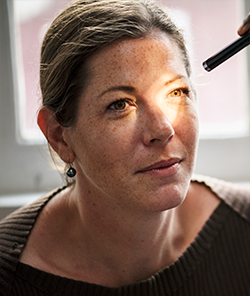 I don't know which doctor I'm supposed to see for this. A retinal specialist? Mine told me "there's nothing out there" -- which was factually wrong. A genetic counselor? They interpret your mutations but don't track the treatment landscape. A low-vision specialist? They help you cope with what you have, not plan for what's coming. Your primary care doctor? They've probably never heard of Usher syndrome. I'm still not sure which one I'm supposed to call.
After months of building context with AI tools, I found four active clinical trials I likely qualify for -- trials no doctor had ever mentioned. Not through a genetic counselor. Not through a patient organization. I used an AI assistant -- and I need to be very clear about what that means.
Through that work, I learned more about my treatment options than I had in fourteen years since my diagnosis. I described my genetic mutations, my visual field, my acuity, and asked: what's out there for me?
This isn't a criticism of doctors. It's a structural problem.
Doctors have limited time, and their patients have hundreds of conditions. They focus on the ones they see most -- which makes sense for them but fails anyone with something rare. The rarer your condition, the wider the gap. And Usher syndrome, at 1 in 10,000 to 1 in 25,000, is very rare.
Your retinal specialist might see one or two USH patients a year.
They can't track the trial landscape for every rare condition they encounter. "Nothing's out there" isn't malice -- it's the default answer that takes zero research time for a condition that represents a fraction of their practice. And even if they wanted to dig deeper -- there's no billing code for it. Insurance pays doctors for visits and procedures, not for spending a hundred hours researching one patient's rare condition. The system doesn't allow it. That's why I learned to do it myself -- and why I'm writing this essay, so you at least know what questions to bring to the conversation.
And it gets worse. Even if a doctor wanted to help you navigate the treatment landscape, they don't have the tools.
There is no system in any hospital or clinic that takes a patient's genetic profile, cross-references it against active trials, weighs the strategic implications of treatment order, and produces a personalized roadmap. That tool doesn't exist. Not in the biggest research hospitals. Not in the most funded medical centers. With all the money in the healthcare system, nobody has built it.
The result is that patients like me are on their own.
I'm doing what a specialist should be doing for me -- reading trial databases, understanding eligibility criteria, thinking about which therapy to pursue, and in what order. I'm doing it because nobody else will. And the system that tells me "don't self-diagnose" is the same system that offers me nothing in return.
I have an engineering background, decades of technical experience, and access to AI tools. What about the patient who doesn't?
A WORD ABOUT AI (READ THIS CAREFULLY)
I want to be direct about the AI part, because I don't want anyone to read this essay and do something dangerous.
When I say I used AI to research my treatment options, I am not saying I opened a free chatbot and asked "what clinical trial should I join?" That would be reckless, and the results would be unreliable.
Here's what I actually did:
I use a paid, top-tier AI model -- not a free chatbot. I pay for the most capable plan available because the quality of the reasoning matters when you're dealing with medical decisions. I fed it my full genetic test report, my audiogram, my medical history, my visual field measurements. I built context over hundreds of hours of conversation -- not one quick question.
And critically: I verified everything. AI gets things wrong.
It can hallucinate trial names, invent eligibility criteria, confuse one therapy with another. I caught errors and corrected them. I cross-checked every claim against ClinicalTrials.gov, published research, and organization websites. When the AI said something I couldn't verify, I threw it out.
This is a skill, not a shortcut. I have 39 years of engineering experience that taught me how to evaluate technical information critically. Even with all of that, what I find may not be 100% right. The treatment landscape changes weekly. A trial that was enrolling yesterday may have stopped today.
PLEASE DO NOT READ THIS ESSAY AND GO ASK A FREE AI CHATBOT WHAT TRIAL YOU SHOULD JOIN.
The information you get may be outdated, incorrect, or completely fabricated.
On top of that, most AI models -- free or paid -- only know what existed when they were trained, and that data is typically six months to a year old. In a landscape where trials open and close every week, the AI might confidently tell you about a trial that's already full, failed, or never existed. AI is a powerful research tool -- but only if you bring deep context, verify everything, and understand its limitations.
What I found through months of careful research was more than my doctors had told me in fourteen years. That's real. But I didn't find it by typing a question into a chat box. I found it by doing the hard work that someone in the medical system should be doing for patients like us.
THE HEARING SIDE (A STARK CONTRAST)
I have Usher syndrome, which means I'm losing both vision and hearing.
Everything I've written above is about the vision side -- and the vision side has over 50 active trials. Three therapies are approaching FDA approval right now.
The hearing side?
As of February 2026, there are exactly four legitimate clinical trials for genetic hearing loss. All four target a single gene -- OTOF -- which causes auditory neuropathy, not Usher syndrome.
For Usher syndrome hearing loss -- any type, not just mine -- there are zero trials. Not one. Not even preclinical. And the OTOF trials can't help us -- they fix a signaling problem in otherwise healthy hair cells. Usher syndrome damages the hair cells themselves. It's a different problem entirely. I've had hearing loss since birth. Fifty trials for my eyes. Zero for my ears. And for those with Usher Type 1 who also deal with balance problems -- there's nothing on that front either. I'm not sure what to do with any of that.
The USH2A gene is too big for AAV delivery to the ear, just like it's too big for the eye. But while vision researchers have found creative workarounds -- gene-agnostic approaches, neuroprotection, optogenetics -- nobody has done the same for hearing. The cochlear damage in Usher syndrome happens during development, and by adulthood, it may be structural damage that gene therapy can't reverse.
Meanwhile, the hearing treatment space is flooded with false hope. Hair cell regeneration therapies that showed zero benefit in Phase 2 trials. Companies that raised millions and then dissolved. Stem cell clinics charging $5,000 to $30,000 for unproven treatments. Supplements marketed as hearing restoration with no clinical evidence.
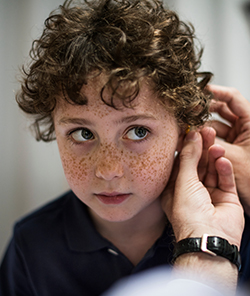 For now, hearing aids and eventually cochlear implants remain the only proven interventions for Usher syndrome hearing loss. I mention this not to be discouraging, but because honesty matters more than hope. The vision landscape is genuinely exciting. The hearing landscape is not there yet.
Knowing the difference protects you from spending money and hope on things that don't work.
WHAT SHOULD EXIST
After all of this research, here's what I think is missing. Not what I want someone to build -- what patients need, right now, and don't have.
A plain-language explanation of why treatment order matters. Why doing one treatment first can block a better one later. Why being "untreated" is actually an advantage when applying for clinical trials -- even though nobody told you that. This information exists in medical journals. It needs to exist in words that patients and families can actually understand.
A framework for thinking about your options.
Not medical advice. Not "do this." But a set of questions: Given your gene, where you are in the progression, your age, and what's available -- here's what to ask your doctor. Here's what to look up before you enroll in anything.
A compatibility guide.
Which treatments can you combine? Which ones might exclude you from future trials? If you do gene therapy in one eye, what does that mean for the other eye, and for future options? These aren't hypothetical questions. People are making these decisions right now, without guidance.
Someone -- anyone -- in the medical system who thinks about this from the patient's side. Right now, researchers think about their trial. Doctors think about their specialty. Organizations think about enrollment. Nobody is thinking about the patient sitting in the middle of it all, trying to figure out which door to walk through when every door might close others behind it.
WHAT I'M DOING ABOUT IT
I'm writing this essay, for one thing.
Because the first step is making the invisible visible. If you didn't know treatment order mattered, now you do. If you didn't know your gene size determined your options, now you do. If you didn't know that a simple oral pill might be a smart first move because it's unlikely to limit your future options -- now you know.
I'm not a doctor. I'm not giving medical advice.
I'm an engineer with Usher syndrome who built his own research tools because nobody else would do this work for him. That fact alone tells you something is broken.
Roughly half of all Usher syndrome patients have USH2A -- the hardest gene to treat. Millions more have non-syndromic RP. All of us face some version of this same problem: the science has raced ahead, and the guidance hasn't followed.
The science is extraordinary. Researchers are doing brilliant work. But between "here are 50 trials" and "talk to your doctor," there's a gap the size of the Grand Canyon. That gap is where patients live.
This essay is the beginning of filling it. Not with answers -- with questions. The right questions.
Because once you know what to ask, you can start finding your own answers.
And if your doctor can't help you navigate it, at least now you know what to navigate.
I wrote this about Usher syndrome and retinitis pigmentosa because that's what I live with. But this gap -- between the science racing forward and the guidance standing still -- exists across every disease where clinical trials are the path to treatment. If you're facing that gap in your own world, whatever the condition, the same questions apply. Which trial first? What am I giving up? Who's helping me decide? And if the answer to that last question is "nobody" -- then we share the same problem, and it's time we all started talking about it.
Five years ago, there was nothing. Today, there are over 50 trials and three therapies approaching approval. For the first time in the history of these conditions, real treatments are within reach. The gap I've described in this essay is real -- but so is the progress. We are closer than we have ever been.
I hope this essay opens some eyes --
Not just to the science, but to the pain of not knowing where to turn, not having anyone to help you make sense of it all. If it reaches a doctor, a researcher, a genetic counselor, a patient organization, anyone who can help close this gap even a little -- then it was worth writing. No one should have to navigate this alone.
WHERE THINGS STAND: FEBRUARY 2026
The treatment landscape changes fast.
Below is a snapshot of what's active or approaching approval as of this writing. Verify current status before making any decisions.
APPROACHING FDA APPROVAL:
- MCO-010 (Nanoscope) -- Optogenetic therapy for advanced RP, any gene. BLA under FDA review.
- OCU-400 (Ocugen) -- Gene-agnostic gene therapy for any RP. BLA submission expected H1 2026.
- DB-OTO (Regeneron) -- Hearing gene therapy for OTOF hearing loss only (not USH).
PHASE 3 / LATE-STAGE TRIALS:
- NPI-001 (Nacuity) -- Oral pill, neuroprotection. For all USH/RP. Breakthrough Therapy Designation, 485 patients enrolled.
- NAC Attack (Johns Hopkins) -- Oral pill, neuroprotection. For all RP. ~438 patients across 30 sites.
- Laru-zova (Beacon) -- Gene therapy for RPGR/X-linked RP. Phase 2/3.
PHASE 1-2 TRIALS (SELECTED):
- AAVB-081 (AAVantgarde) -- Dual-AAV gene therapy for USH1B (MYO7A).
- Ultevursen (Sepul Bio) -- ASO exon skipping for USH2A exon 13 only.
- SPVN06 (SparingVision) -- Cone preservation for all RP (gene-agnostic).
- jCell (jCyte) -- Retinal progenitor cells for all RP (gene-agnostic).
- OpCT-001 (BlueRock/Bayer) -- iPSC cell replacement for advanced RP.
- CTx-PDE6b (Coave/EyeDNA) -- Gene therapy for PDE6B mutations.
- BF844 -- Small molecule for USH Type 3 (CLRN1).
- ZVS203e (ZVS Bio) -- CRISPR gene editing for RHO mutations (first CRISPR for RP).
THE BIG PICTURE:
- Gene-specific vision trials: 22+ active. Closest: Laru-zova (RPGR), ultevursen (USH2A exon 13).
- Gene-independent vision trials: 15+ active. Closest: MCO-010, OCU-400, NPI-001.
- Hearing trials (all genes): 4 active. Closest: DB-OTO (OTOF only).
- Hearing trials for USH: 0. Nothing.
RESOURCES AND DISCLAIMERS
This essay reflects one patient's research as of February 2026. It is not medical advice.
Link to Mark's Facebook essay:
Key resources:
- ClinicalTrials.gov: https://clinicaltrials.gov
- Foundation Fighting Blindness Clinical Trial Pipeline: https://www.fightingblindness.org/clinical-trial-pipeline
- USH Coalition Clinical Trials: https://www.usher-syndrome.org/research/clinical-trials.html
- My Retina Tracker (free genetic registry): https://www.myretinatracker.org
More from Mark Hubers
Two places to find everything courtesy of Mark Hubers:
Facebook: facebook.com/USHEngineer
Essays: ushengineer.substack.com
child-hearing-check
© <a href='https://www.123rf.com/profile_rawpixel'>rawpixel</a>, <a href='https://www.123rf.com/free-images/'>123RF Free Images</a>
woman eye exam
© <a href='https://www.123rf.com/profile_rawpixel'>rawpixel</a>, <a href='https://www.123rf.com/free-images/'>123RF Free Images</a>